
Process!

This week we finished drafting and creating our Courage Projects. We implemented phrases that have Kind, Specific, and Helpful thoughts to encourage one another to make this clearer for an audience. We also used our rubrics as tools to evaluate where our work was, and we also used those descriptors to help us "level up" and elevate the quality of our work.


This week we finished drafting and creating our Courage Projects. We implemented phrases that have Kind, Specific, and Helpful thoughts to encourage one another to make this clearer for an audience. We also used our rubrics as tools to evaluate where our work was, and we used those descriptors to help us "level up" and elevate the quality of our work.

In reading, we've been examining characters -- analyzing traits, determining their struggles, and identifying ways they changed. We have been learning to prove our thinking with evidence from the text too. In our word work, we looked at ways sounds come together in words as well as webbed them to connect with other words to expand our understanding. We started our first week of language study too -- examining complete sentences and how they are built with subjects and predicates. It's time to be held accountable for capitals at the beginnings of our sentences and having ending punctuation -- IN ALL OF OUR WORK. Our drafting, revising, and editing of our personal map pieces is almost done too -- almost ready to publish!

Our mathematicians continue to deepen their understanding of place value. We finished solving the Deca tree problem in small groups, then each group presented their work to our mathematical community. We listened and offered questions and critique as each group shared their representations, solution, informative mistakes, and generalizations. We also solved our first two PODs (problem of the day). Each POD is a differentiated word problem that we solve with a strategy called UPS check. As your student will tell you, this powerful strategy empowers us to notice and deeply understand all of the relationships in a word problem. We ended the week with a fun place value scavenger hunt around the room.

We enjoyed seeing so many of you at Back to School Night. We really appreciate the support you give us, and are excited to continue building our relationships with you.

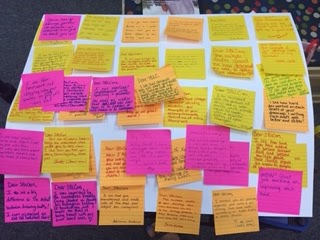
 We shared your wonderful feedback with the kids...here's a glimpse -- they were over the moon with excitement to read what you had written to them. They asked for more time to make more improvements -- see the power?

We hope you have a restful weekend!


Comments

Popular posts from this blog

Texas Regions

*Parents, this is an in-class assignment. Hello, SBLC Super Stars! Today, you are explorers of the four Texas regions. If you get finished--AND your have double checked your work--please make a comment that includes your name and something you enjoyed learning today! Directions : Carefully read below and use the links to investigate the characteristics and history of each region. Remember to write neatly and double check spelling...everything you do deserves your best effort! :) 1. A  sub-region  is a smaller part of a region or area. What are the sub-regions within each Texas region? Look at the picture below to see how to record your findings in your notebook. Now, click here to find your answers:  http://bookbuilder.cast.org/view_print.php?book=41216 2. On the next two pages in your notebook, create a half-page "fact sheet" for each region. Set your pages up first! Use a ruler to make straight lines and create a half page for each region. ...

Force & Motion Websurf

Hello, scientists! Use the websites below to understand more about force, motion, and energy. Remember to read the directions and ALL information on the sites. When you are finished, leave a comment answering one of the questions posted in class . Remember to check spelling, capitals, and punctuation before you publish your comment! 2nd & 3rd grade Part I: Friction http://www.bbc.co.uk/schools/scienceclips/ages/8_9/friction.shtml Part II: How Pulleys Work http://www.neok12.com/php/watch.php?v=zX56004f445662567a447c45&t=Simple-Machines Part III: Forces in Action http://www.bbc.co.uk/schools/scienceclips/ages/10_11/forces_action.shtml 4th grade Part I: Forces http://www.bbc.co.uk/bitesize/ks3/science/energy_electricity_forces/forces/activity/ Part II: Parkworld Plot http://www-g.eng.cam.ac.uk/mmg/teaching/peterstidwill/interact/resources/parkworldplot.htm Part III: Friction http://www.bbc.co.uk/schools/scienceclips/ages/8_9/friction_fs.shtml Bo...

Weather Web Surf

Hi, SBLC meteorologists! Use the links below to learn more about the science of weather. If you complete your Web Surf early, please: 1) leave a comment sharing something you learned 2) explore the other grade's weather sites. Be sure to double-check your comment before you publish! :) 2nd grade Part I: Weather Maker http://teacher.scholastic.com/activities/wwatch/sim/game.htm Part II: Be a Scientist! http://www.beaconlearningcenter.com/WebLessons/BeAScientist/default.htm 3rd grade Part I: Texas Weather http://www.wunderground.com/US/TX/ Part II: Texas Annual Rainfall http://web2.airmail.net/danb1/annualrainfall.htm 4th grade Part I: Tips for Forecasting Weather https://scied.ucar.edu/webweather/thunderstorms/make-weather-forecast Part II: Ed Heads Weather http://www.edheads.org/activities/weather/frame_loader.htm Part III: Interactive Weather Maker http://teacher.scholastic.com/activities/wwatch/sim/game.htm